
The Home Simulator Renaissance: Building Your Sanctuary
For the dedicated golfer, the home sanctuary is no longer a luxury—it’s a performance requirement. Incorporating a Golf Simulator into this space can elevate your game to a whole new level. It’s that dedicated space where you can grind through a swing change at midnight or host a high-stakes Saturday skins game with your regular foursome. However, as we navigate the 2026 market, many enthusiasts are falling into the trap of “analysis paralysis” in the face of five-figure investments.
This analysis is tailored specifically for the 5-15 handicap demographic. You’ve moved past the “just for fun” stage and value precise data for personal improvement, yet you remain the ultimate social host. The dilemma? With options ranging from $700 to $25,000, the most expensive choice is often the wrong one for your basement. In 2026, the market is shifting: we are moving away from paying for a logo and moving toward paying for user experience.
Takeaway 1: Why the Most Famous Name Isn’t Always the Winner
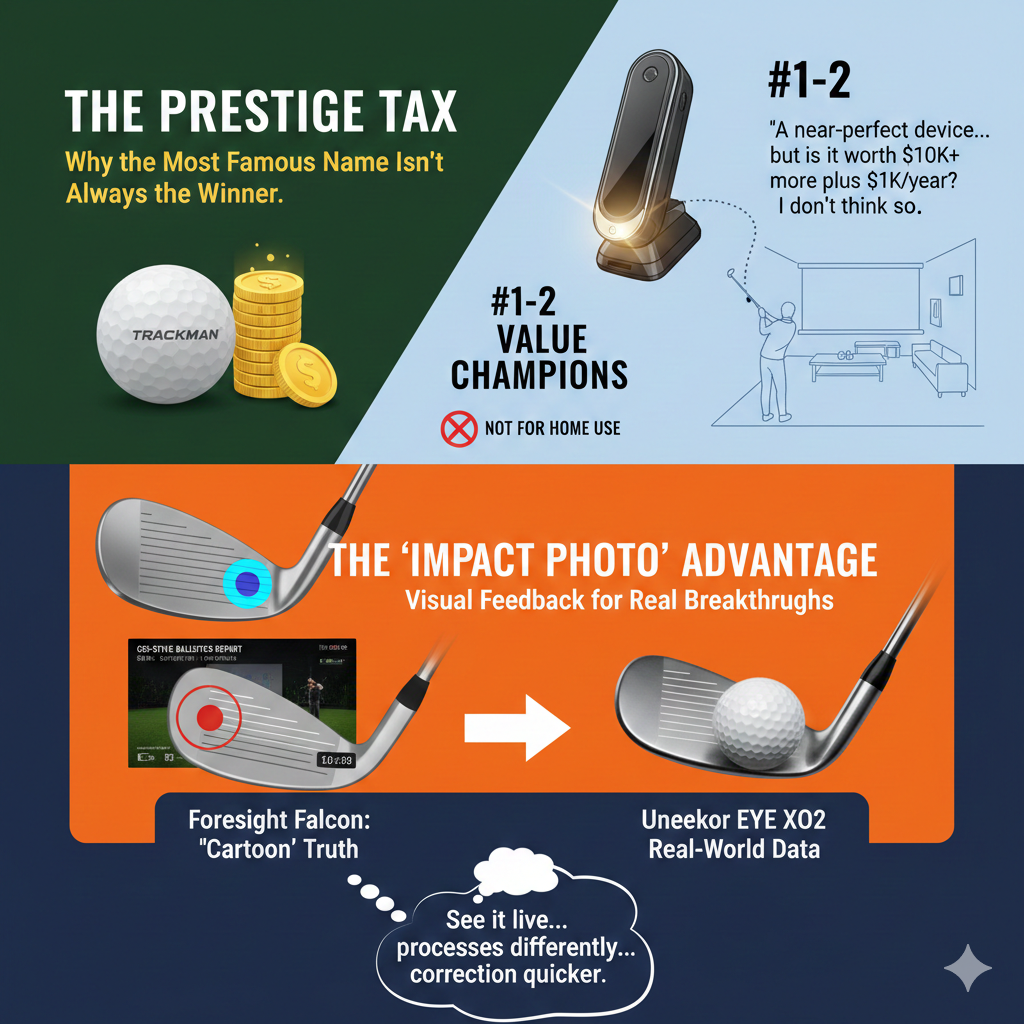
In the world of professional golf, the name Trackman carries a certain “prestige tax.” However, in our 2026 rankings, the Trackman iO (#3) was outperformed by units with significantly lower price points. While it remains a near-perfect device in terms of raw ball data, its “industrial-grade” prestige can actually be a deterrent for the residential 5-15 handicap host.
The Trackman iO commands a price gap of $10,000 to $15,000 over its closest rivals, yet it still tacks on a $1,000 annual subscription fee. For the home user, this feels less like an investment and more like a permanent tax. While the accuracy is undeniably elite, the sheer lack of value relative to the competition makes it a difficult recommendation for anyone not running a commercial facility.
“It’s a near-perfect golf simulator… but is it worth $10,000 to $15,000 more plus $1,000 a year? I don’t think so… I think they’re a little bit overpriced.”
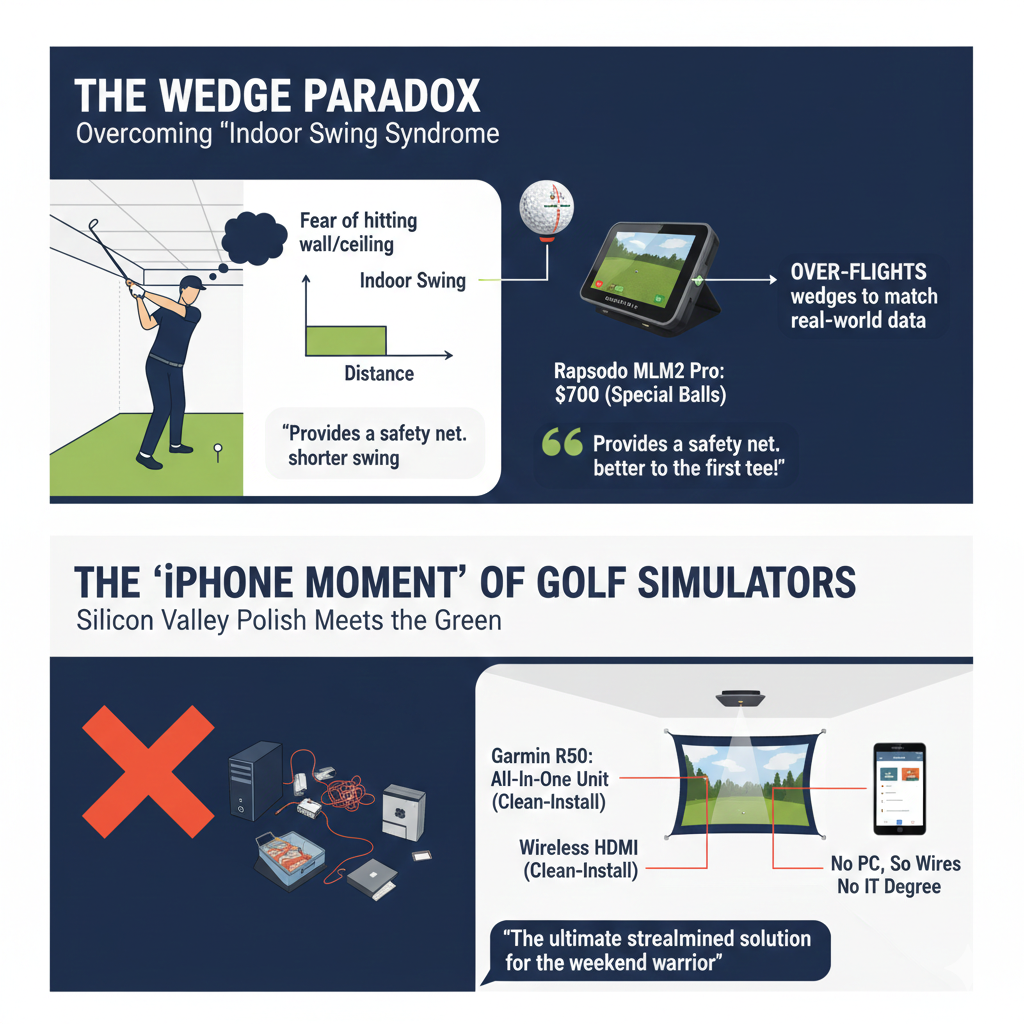
Takeaway 2: The Wedge Paradox—Overcoming “Indoor Swing Syndrome”
One of the most fascinating entries in the 2026 lineup is the Rapsodo MLM2 Pro (#9). At roughly $700, it’s a budget-friendly powerhouse, though it does require specialized balls to unlock its full potential. The “surprise” for many users is that indoor wedge distances on the Rapsodo fly slightly longer than on a premium $20,000 unit.
While a purist might call this an inaccuracy, it is actually a psychological safety net. Most 5-15 handicaps suffer from “indoor swing syndrome”—a subconscious tendency to swing shorter out of fear of hitting a wall or ceiling. Furthermore, on a real course, grass is longer and spin is lower, meaning the ball naturally travels further than it does off a perfect simulator turf lie. By “over-flighting” the wedge, the MLM2 Pro provides a data profile that actually correlates better to your real-world transition from the basement golf simulator to the first tee.
Takeaway 3: The “iPhone Moment” of Golf Simulators
The Garmin R50 (#4) represents a fundamental shift in hardware philosophy. We call this the “iPhone moment” of the industry. Just as Apple combined a phone, an internet device, and a music player, the R50 has brought the Silicon Valley polish of an “all-in-one” unit to the simulator world.
The R50 eliminates the need for a separate high-end PC, complex wiring harnesses, or dedicated tech support to get running. It features a built-in screen for “net and mat” setups, but the real lifestyle benefit is the connectivity. It offers Wireless HDMI to your projector, allowing for a “clean-install” aesthetic that doesn’t require cables running across your floor or ceiling. It’s the ultimate streamlined solution for the weekend warrior who wants a professional feel without the IT degree.
Takeaway 4: The Psychological Power of the “Impact Photo”
When comparing the Uneekor EYE XO2 (#1) against the Foresight Falcon (#2), the technical difference comes down to how your brain processes feedback. The Foresight Falcon is an elite machine, but it provides a “cartoon” version of the truth—a generated digital graphic of where the ball hit the face.
The EYE XO2, however, delivers a “CSI-style ballistics report.” It provides actual high-speed, slow-motion video and a high-resolution photo of the real ball-to-face impact. For a 5-15 handicap trying to fix a persistent heel-strike, seeing the actual ball compress against the metal is the difference between a wasted practice session and a breakthrough.
“Golfers who actually see it live on a video, it just processes in your brain differently and helps you make that correction much quicker.”
Takeaway 5: The “Hidden” Value of Modular Upgrades
For those starting their journey with golf simulators, the FlightScope Mevo+ Gen 2 (#7) offers a sophisticated “pay-as-you-go” model. Starting at just $1,000 with no subscription fees, it’s a low-barrier entry point into elite radar tech. However, an elite consultant’s tip: to hit that 99% accuracy mark, you must use Titleist RCT balls.
The brilliance here is scalability. You can start with base ball data and later upgrade via software to the “Pro Package,” allowing a $1,000 unit to eventually compete with $5,000 units. This is a massive advantage over hardware like the Square Golf (#10), which—while accurate for its price—requires physical relocation for left-handed and right-handed players, making it a “pain” for social hosting.
Takeaway 6: The “Subscription-Free” Premium Advantage
If you are moving into the “Tier 1” range, you have to look at the long-term ROI. The Foresight Falcon and the Uneekor EYE XO2 represent the gold standard of golf simulators for the serious home setup. The Uneekor EYE XO2 typically sits at a $10,000 price point (often dropping to $8,000 during holiday sales), which, while significant, is a “one-and-done” investment.
The critical distinction for the social golfer is the overhead form factor. Units like the Falcon and EYE XO2 stay put on the ceiling. This is the “holy grail” for hosting mixed-handed groups; you never have to move the hardware between shots. When you factor in the lack of annual subscription fees, these units eventually become more affordable than “cheaper” alternatives that bleed you for $1,000 every single year.
Conclusion: Choosing Your 2026 Champion
The 2026 market has proven that “pure accuracy” is now the baseline, not the differentiator. When choosing your setup, the question is no longer “is it accurate?” but rather “will I actually use it?”
Do you value the prestige of a famous brand logo, or the reality of a high-speed video replay? For the 5-15 handicap golfer looking to shave those last few strokes off their game, the visual feedback of an impact photo is worth more than any prestige tax. If you plan to be the social hub of your golf circle, prioritize overhead units that allow for seamless lefty/righty play. In the modern market, the best simulator isn’t the one that costs the most—it’s the one that eliminates the friction between you and the perfect swing.


Very helpful and easy to read.
wish you all the best
I learned something new from this post.
wish you best and best
This really helped me a lot.
Appreciate the effort you put into this.
wish you all the best